The Business Case for Your New Data Architecture
Dec 24, 2025
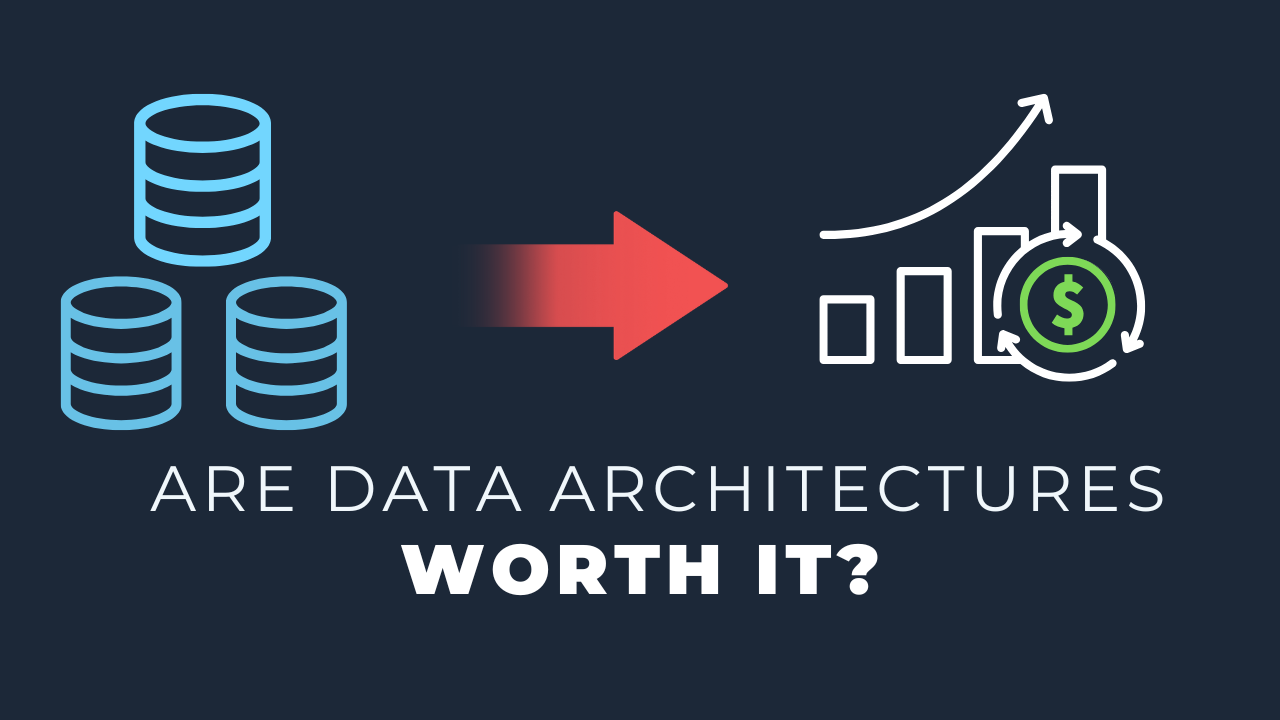
Making the business case for a new data architecture starts with accepting an uncomfortable fact: for most companies the data team is a cost center, not a revenue generator. Budget goes first to the people who bring money in, so your proposal is competing against a sales hire. That means the case cannot be that the architecture is better. It has to be that the architecture unlocks insights you cannot produce today, converts wasted engineer time into dollars, lets you hand day to day work to someone more junior, or creates a real competitive edge. Pick the angle your leadership already cares about and make the architecture the means, not the point.
Key takeaways
- Most data teams are a pure cost to the business. Walking into the conversation knowing that changes how you frame everything.
- A better architecture is never the benefit. The benefit is what the better architecture makes possible.
- Scattered data across tools limits the analysis you can even attempt. Consolidation is what makes cross-functional questions answerable.
- Efficiency is the easiest angle to convert into dollars, because engineer time has a known cost.
- A well structured, documented stack lets a junior person take over the day to day, which frees your most expensive person.
- When someone says a tool is too expensive, explain the pricing model and how your design keeps spend down.
Start with the elephant in the room
As data people we naturally understand the value of what we build. We are the first to see the information coming through and the insights sitting inside it.
But we still have to convince somebody else in the organization that this is a worthy place to invest money.
You are a cost center
A cost center is a function the business funds rather than one that earns. Unless data is part of your product, that is you.
Sometimes that is hard to accept. Most of the time we are internal support for the company.
Why that makes funding feel like pulling teeth
From the business side, budget is finite and the first money usually goes to the people generating money. They want to see a return.
That does not mean the work is unimportant. It means you have to understand where the person on the other side of the table is coming from before you can get your point across.
Angle 1: Unlock insights you cannot produce today
This one works especially well at smaller, growing companies. Data is scattered across different tools, and people run reports directly out of those tools and export them somewhere else.
That process limits the kind of real analysis anyone can do. Not because the team is unskilled, but because the data never sits in the same place.
You can see revenue in one tool and marketing spend in another, but nobody can put them side by side without rebuilding a spreadsheet by hand every month.
How to frame it
The framing is forward looking. If we restructure this, we understand the data better and it becomes much easier to get at.
Then, when we want to compare operational data against financial data or marketing spend, we can actually put it together.
- Better decisions for the business because the full picture exists in one place.
- Better support for sales and operations because you can answer their questions without a week of exports.
- New questions become possible that nobody bothered to ask while the answer was out of reach.
The architecture itself is not the benefit. The benefit is that being organized lets new insights happen.
Angle 2: Efficiency, which converts to dollars
Efficiency on its own is not interesting to a finance lead either. What matters is what the efficiency leads to.
Time not spent on low value work is time spent building better reports, creating new insights, and bringing in new data sources.
The cost of an outdated stack
If you are stuck on a manual, disorganized architecture, that is eating your time. Yes, things technically get out the door, but at a price.
Highlight that your human resources are not being well spent. That translates well to the finance department and to company leadership.
Put a number on it where you can. Hours per week on a manual load, times a loaded hourly rate, is a figure leadership can compare against a tool invoice.
This is the angle that converts to dollars most easily. Engineer hours have a known cost, so hours recovered have a known value.
Angle 3: Free your most expensive person
Here is one people underuse. A well structured stack with good tools and good documentation can be handed to someone more junior.
They take over the day to day work. You step back as the lead or senior engineer and focus on higher value problems.
What blocks that today
The blocker is usually that the current design is scattered, undocumented, and largely stored in your head. That is a key person dependency, and it is expensive.
Without fixing it, you cannot explain the system to anyone else, so you stay stuck maintaining it.
It also makes you a single point of failure. If you are out for two weeks, the pipeline is out for two weeks.
Why leadership likes this one
- Lower cost per hour on the routine work, because a junior person costs less than you do.
- Your time redirected to the work only you can do.
- Someone learns the ropes and grows into a contributor, which is good for them and for the company.
Without the upfront investment, none of that happens. You keep patching something together, and breaking out of that cycle needs commitment and financial backing.
Angle 4: A real competitive advantage
This is not the most common scenario, but it is worth mentioning when it applies.
Maybe you have a custom process that helps the business secure better deals, or find leads more effectively than competitors can.
When that is genuinely true, it is a strong angle for getting buy-in on a data initiative, because it moves the conversation from cost to advantage.
The test is whether a customer or a prospect would notice the difference. If the answer is yes, that argument belongs at the front of the conversation.
Handling the "it costs too much" objection
The last piece is about pricing structures, and the objection that a tool is too expensive or that you do not need that much capability.
Sometimes that is just true and you do not need something over the top. But for core components it usually is not.
The database is where this comes up
The database is the component that triggers this objection most often. The fix is to explain the pricing model rather than defend the tool.
Show how your design uses a good tool while deliberately limiting cost. That is a much stronger position than asking for a bigger number.
Pay-as-you-go versus fixed fee
Cloud warehouses typically bill on consumption, while traditional databases charge a fixed fee. Each one plays mental games with you in a different way.
Under consumption pricing, a cheap looking tool gets expensive through careless queries and unnecessary full refreshes. Under a fixed fee, you pay the same whether you use it well or not.
Knowing which model you are buying into, and which tactics reduce spend under it, is often the whole objection handled.
We are a cost for the business, and it is still important to keep investing in data infrastructure. Both of those are true at once, and the business case is where you reconcile them.
Key terms
Cost center
A function the business funds rather than one that generates revenue directly, which is the position most internal data teams argue from.
Business case
The argument that connects a technical investment to an outcome leadership already values, such as revenue, recovered time or reduced risk.
Efficiency savings
Engineer hours recovered by removing manual work, which is the easiest data team benefit to express in dollars.
Key person dependency
A setup where the system can only be run by the one person who built it, usually because it is undocumented and scattered.
Pay-as-you-go pricing
A consumption based billing model used by most cloud warehouses, where design decisions directly control the monthly bill.
Common questions
How do I justify a data warehouse to leadership?
Do not justify the warehouse, justify what it enables. Name the questions the business cannot answer today, the hours your team loses to manual work, and the person who is stuck maintaining something nobody else can run. The warehouse is the mechanism, not the pitch.
What is the strongest argument for data team budget?
Efficiency, because it converts to dollars with the least hand waving. Engineer time has a known cost, so hours recovered have a number attached. Insight and competitive advantage are more valuable but harder to price.
How do I respond when a tool is called too expensive?
Explain the pricing model and show how your design keeps spend down. Most objections are about an unbounded bill rather than the tool itself. A clear picture of what drives cost usually resolves it.
Is it worth investing in data architecture at a small company?
Often yes, because small companies feel the scattered data problem most acutely. The investment does not have to be large. It has to remove the specific bottleneck that is costing you time every week.
What if leadership still says no?
Treat it as information about priorities rather than a verdict on the work. Find the angle they do care about, usually a cost or a risk they already feel, and attach the smallest useful piece of the architecture to it.
Related reading
- Common Pricing Models of Data Tools
- What's the Value of Analytics?
- The Long-Term Impact of the First Data Team Hire
- What Every Data Team Lead Should Know
Final takeaway
Every architecture project I help a team scope eventually runs into the same gate, which is someone outside the data team deciding whether it is worth the money. Lead with the outcome that person already cares about and treat the architecture as how you get there.
Additional Free Resources
Starter Guides & Checklists
Explore additional free resources built on the same patterns I use with real clients so you can build your own with structure and confidence. Topics include data architecture, modeling and more specifically for small data teams.