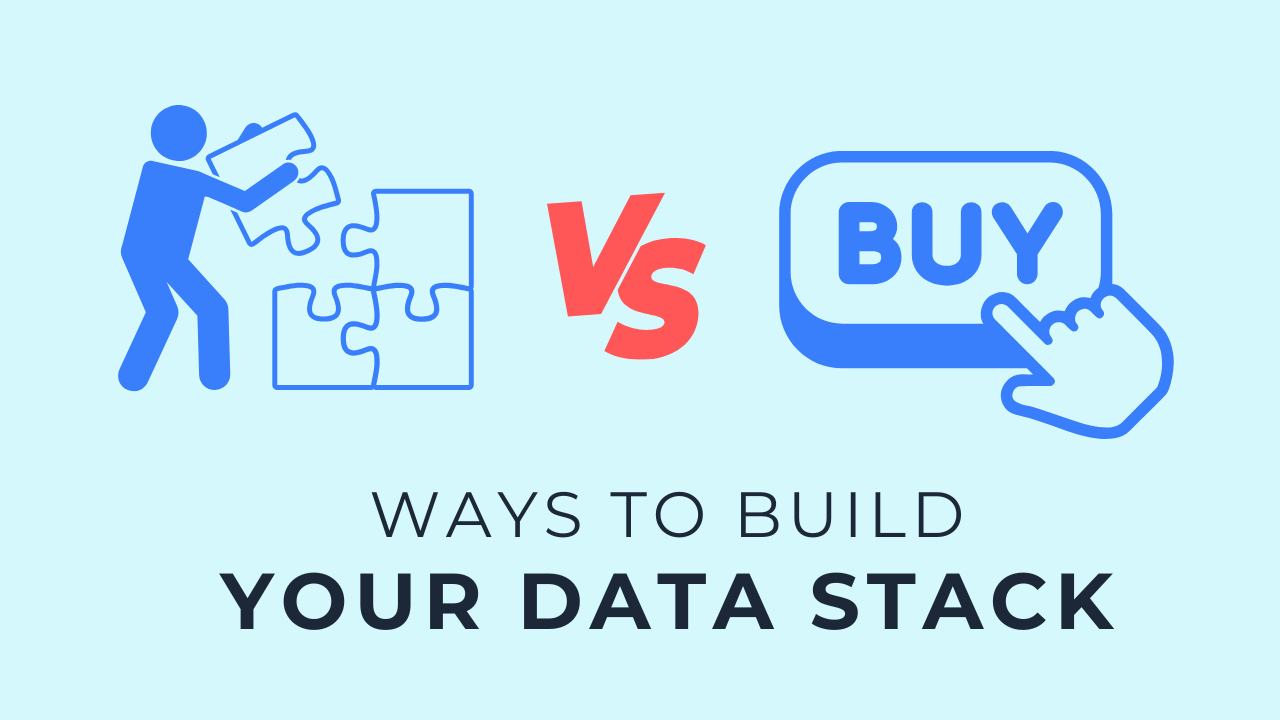
Build vs Buy: What's best for your data team?
Oct 23, 2025
Build versus buy comes down to three questions. First, what is the total cost of ownership, which for a custom build means the salary of everyone who builds it, maintains it, documents it and supports it, not just the license fee you avoided. Second, is the data work a genuine competitive advantage for the business, or is it a supporting function that produces insights so other people can make better decisions. Third, does your team have the skill set to maintain and scale what you are about to build, including the people who have not been hired yet. For small and one person data teams I usually recommend leaning toward buy, because the hidden costs of building are the ones that come back to bite you.
Key takeaways
- Buying has a cost you can calculate. Building has a cost you have to estimate, and the estimate is usually low.
- The real price of a custom build is human capital: salary, rate or project fee, for the initial build and for every year of maintenance after it.
- You can only do one thing at a time. Hours spent fixing your own tooling are hours not spent delivering insight to the business.
- Task switching has its own cost. Constant small maintenance interruptions make deep work on real initiatives much harder.
- Custom builds create tribal knowledge. If the person who built it leaves, whoever replaces them inherits a system with no vendor documentation and no support line.
- If your data work is a true competitive advantage, custom is worth the investment. If it is internal reporting and analytics, it usually is not.
- Data ingestion from unusual source systems is the most common place where building a custom piece still makes sense.
Start with total cost of ownership
Whether you are standing up an architecture from scratch or scaling one you already have, you eventually have to choose tooling. Build something custom, or buy something off the shelf.
The first thing to look at is total cost of ownership, meaning everything it costs to run the thing over its life, not the price on the pricing page.
Buying is the easy side to price. It is a license fee, or a usage charge, or a volume charge. You can more or less calculate it in advance.
Building is the gray side, and that gray area is exactly where I think the decision should be focused.
Human capital is the real line item
Every person responsible for building something from scratch has a cost attached. A salary, an hourly rate, a project fee. Nobody is doing it out of the goodness of their heart.
That cost applies twice: once to build it, and then continuously to maintain it. The maintenance half is the part that gets left out of the comparison, and it is often larger than the license fee you were avoiding.
For a small or one person team this is the whole argument. You can only do one thing at a time. Time spent building, debugging and patching custom tooling is time not spent producing the insight your company actually hired you for.
Ease of use and support
When you buy, someone else already solved the boring parts. There is an interface, there is documentation, and there is a support channel when something breaks.
You have effectively outsourced that responsibility. When you build, you own all of it, including the tedious details nobody budgets for.
Individually those are small tasks. Collectively they are a second job.
The cost of task switching
Interruptions have a price of their own. Every time you drop a project to fix your own tooling, you pay again to get back into focus.
Do that daily or weekly and it becomes very hard to go deep on a large initiative. Some teams manage it well, but it takes deliberate effort. Left alone it turns into a steady distraction.
Documentation and tribal knowledge
The last piece of ownership cost is documentation. Build custom and you create tribal knowledge, meaning understanding that exists only in one person's head.
Imagine you built everything yourself and then you leave. Someone new steps in and has to reverse engineer it with no vendor docs and nobody to ask.
When you buy, the vendor's team carries that burden. These are small things that compound, and they are a large part of why I lean the way I do for small teams.
Is data a competitive advantage for your business?
The second question is about the role of your team inside the company.
Is the business using what you build to win in the market, or is it internal reporting and analytics that helps people make better decisions?
Both matter. They justify very different levels of investment.
When custom is worth it
If the data work genuinely is a competitive advantage, custom may well be the right call. You are building something that directly affects profitability, so dedicating engineering time to make it excellent is a reasonable trade.
Something I have come to appreciate more since going independent: a data team is a cost to the business. We are not sales reps and we do not generate revenue directly.
That is not a knock on the work. Good insight is essential to a healthy company. It does mean the honest question is what is actually required to deliver on a supporting mission, as efficiently as possible.
Where custom still wins: ingestion
You will never get as much control or customization from a purchased product as from something you wrote. If that control genuinely serves a need, build it.
In the data world the place this comes up most is ingestion. Some source systems are unusual enough that no off the shelf connector exists, and a custom connector becomes the exception inside an otherwise purchased stack.
Even then, there are usually ways to limit how much you customize. The caution is not to get carried away building things that are fun rather than advantageous.
Be honest about skill set, now and later
The third consideration is skill set. Not just the skills on the team today, but the ones you expect to have when people join or leave.
If you build custom, you are the one responsible for documentation, best practices and making the thing transferable. Otherwise it stays locked in one person's mind.
The hiring consequence
Say you are a strong Python developer and you wrote a set of custom integrations. What happens with the next hire?
The company now needs to recruit someone who is at least a competent Python developer just to keep the lights on. That is not impossible, but it narrows the hiring pool and it costs money.
Buy instead and there is training, public documentation and an established set of practices that a new person can pick up.
Can it scale with you?
Your current skills were enough to build what exists today. The question is what happens when expectations grow.
More customization requests, more volume, more stakeholders. Will you maintain all of that in house, or does it slowly become the job?
That is the risk with custom tooling over time: maintaining it crowds out everything else. Buying outsources the development, the maintenance, the scaling and the keeping up with best practices to a company whose entire business is doing that.
Where I land
There is no universal answer here, and plenty of the time the honest response is that it depends.
That said, for small and one person data teams I usually recommend leaning toward buy. It can feel like you are adding an expense you did not need.
The expense you avoided is rarely the expense that hurts you. It is the human resource cost, the ongoing maintenance and the ceiling you put on your own ability to scale that show up later.
Key terms
Total cost of ownership
Everything it costs to run a tool over its life, including license fees, usage charges and the human time to build, maintain, document and support it.
Human capital cost
The salary, rate or project fee attached to the people who build and maintain a custom solution, which is usually the largest part of a build decision.
Task switching
The time and focus lost every time an engineer drops a project to handle maintenance, which compounds when the interruptions are frequent.
Tribal knowledge
Understanding of a custom system that lives only in the head of the person who built it, with no documentation for anyone who comes next.
Custom connector
A hand built data ingestion integration for a source system that no off the shelf loader supports, and the most common justified exception to buying.
Common questions
When does building custom data tooling actually make sense?
When the thing you are building is a competitive advantage for the business, or when no vendor supports the source system you need. Both cases justify the ongoing maintenance because there is no equivalent you could have purchased. Outside those cases, the maintenance usually outweighs the control you gain.
How do I estimate the cost of building something in house?
Price the hours, not just the project. Estimate the build, then estimate annual maintenance, support, documentation and onboarding, and multiply by a realistic loaded hourly rate for the people doing it. Compare that total against the vendor's annual cost, not against zero.
Is buying a tool always more expensive than open source?
Only on the invoice. Self hosted open source moves cost from the license line to the payroll line, where it is harder to see and often larger. The comparison only works if you count your own setup, support and upgrade hours.
What is the biggest risk of a custom build on a one person team?
Concentration. Everything depends on one person who also has to deliver reports, run pipelines and answer stakeholders. If that person is unavailable or leaves, the business inherits an undocumented system and no support contract.
Can I mix building and buying in the same stack?
Yes, and most teams should. Buy the parts that are solved problems, such as the warehouse, orchestration and the bulk of ingestion, then build only the narrow pieces nothing covers. The goal is to keep the custom surface area as small as possible.
Related reading
- The Hidden Cost of Open Source
- Common Pricing Models of Data Tools
- How to Pick Tools for a Data Stack
- Avoiding Vendor Lock-in With Your Data Stack
Final takeaway
Most of the small teams I work with come to this decision assuming the license fee is the expensive part. It almost never is. Count the maintenance hours honestly, and the build option stops looking like the thrifty one unless the thing you are building is genuinely what makes the business different.
Additional Free Resources
Starter Guides & Checklists
Explore additional free resources built on the same patterns I use with real clients so you can build your own with structure and confidence. Topics include data architecture, modeling and more specifically for small data teams.