The Modern Data Viewpoint (3 Principles)
Dec 03, 2025
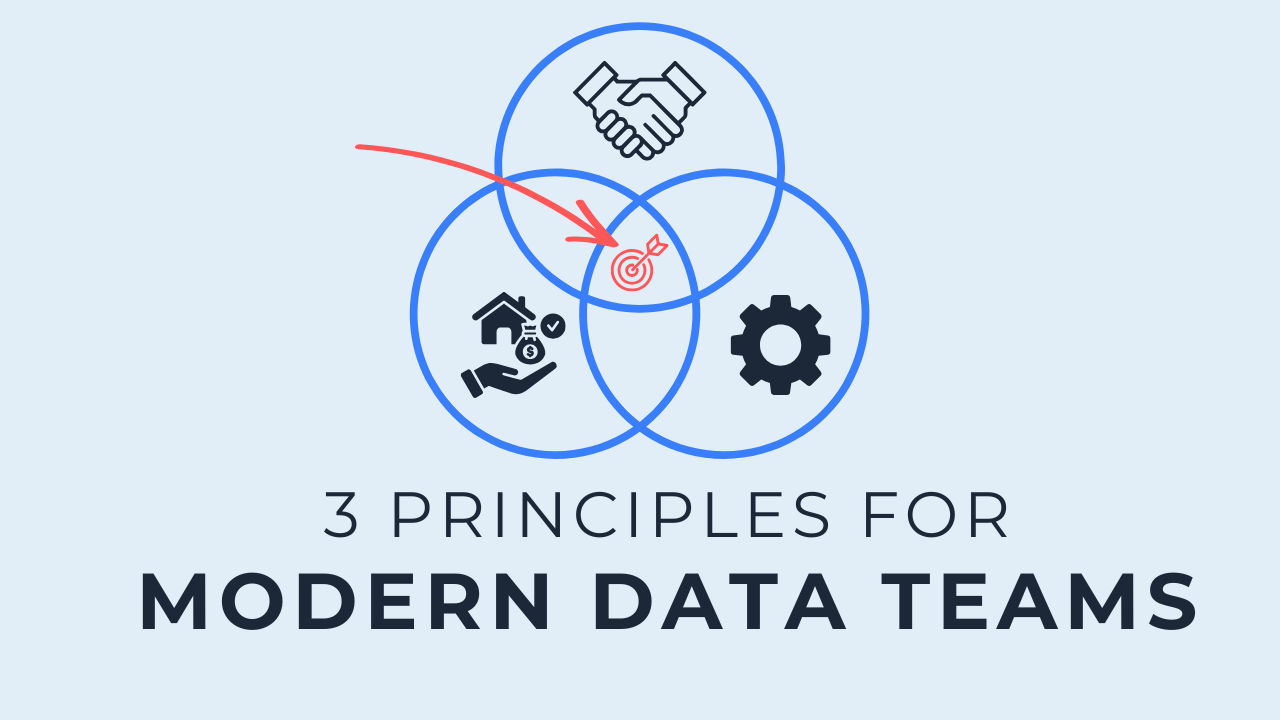
The modern data viewpoint comes down to three principles: analytics is collaborative, analytics code is an asset, and analytics requires automated tools. It was championed by the people at dbt Labs, and it describes a posture toward the work rather than a tool you install. Collaborative means version control, quality assurance, documentation and modularity. Code as an asset means environments, service level guarantees and designing for maintainability. Automated tools means you should be able to run the whole pipeline with a single command instead of doing things by hand that software engineers stopped doing years ago. Building a good architecture depends at least as much on this perspective as on which tools you pick.
Key takeaways
- The viewpoint is a perspective on analytics, not a product. It is what makes the tooling make sense.
- Tristan Handy's line sums up the motivation: analytics teams have a workflow problem.
- Data work was historically rigid while software engineering got fluid and automated. The viewpoint is an attempt to close that gap.
- Principle one, analytics is collaborative: version control, quality assurance, documentation and modularity.
- Principle two, analytics code is an asset: real environments, service level guarantees, and design for maintainability.
- Principle three, analytics requires automated tools: if a person has to do it by hand every time, that is a gap.
- Columnar databases are where analytics went, and they are part of why this way of working became practical.
Where the viewpoint comes from
Building a solid data architecture is more than the tools you pick or the skills you have. A lot of it comes down to your overall perspective on analytics as a whole.
That idea of a viewpoint has been championed particularly well by the people at dbt Labs. I refer to it as the dbt viewpoint, though nothing here is affiliated with them. This is my interpretation of what they published.
What follows was originally a lesson I recorded for a dbt course a few years ago. The ideas have aged better than most things in this field.
Analytics teams have a workflow problem
The quote I start with is from Tristan Handy, the CEO and founder of dbt Labs: analytics teams have a workflow problem.
That single line summarizes the whole motivation. Data has long been its own little world inside companies, with its own way of doing things and no formal workflow.
The gap with software engineering
Software engineering became modern, automated and fluid. Data stayed rigid. You build something, deploy it, make a report, repeat.
Bridging that gap, and specifically how teams work together while doing it, is a large part of what the viewpoint is about.
A short history of data engineering
It helps to see where the current approach came from, because none of it was obvious at the time.
Early 2000s
Traditional on premise databases, managed almost exclusively by DBAs, short for database administrators. The idea of a data team is not really a thing at most companies yet.
Mid to late 2000s
Nearly every company has a data warehouse or is building one. ETL pipelines bring a more structured way of moving data, and the volume keeps growing.
By 2008 and 2009 the social media companies are reshaping both how data looks and how we interact with it as a society.
Early to mid 2010s
Cloud computing arrives in force with Azure and Google Cloud. At the same time, data teams get more siloed.
People across the company become more data literate, so instead of one centralized team you get one off reports and queries everywhere. Pipelines shift from ETL toward ELT because the volume no longer allows the old approach.
Early 2020s and beyond
Analytics engineering emerges as a discipline, along with DataOps, a more automated and collaborative way of operating than the siloed model before it.
Tooling specializes. One product used to extract, transform and load. Now there is dbt for transformation, Fivetran, Airbyte and Stitch for extract and load, and Tableau or Power BI for reporting.
A few founding dates put it in perspective: SSIS as Microsoft's ETL tool, GitHub in 2008, Snowflake in 2012, dbt in 2016.
Row based versus columnar databases
This distinction matters because it shapes how dbt works under the hood and why some practices make sense at all.
Row based is the traditional kind: SQL Server, Postgres, MySQL. A query reads one row at a time, which suits CRUD operations, meaning create, read, update and delete.
What columnar changes
A columnar database reads by column instead. On very wide tables you only touch the columns you asked for, which is far more efficient for analytics at scale.
The trade is that it is poor at individual transactional writes and updates. Different purpose, different design.
Analytics went columnar, and that is the ground the modern stack is built on. Snowflake, Databricks, BigQuery, Synapse and Redshift are the familiar examples.
If the distinction is new to you, it is worth reading further. Knowing which type you are working on explains a lot about why certain patterns get recommended and others do not.
The three principles
The viewpoint itself summarizes into three statements. Each one unpacks into a handful of practices.
Analytics is collaborative
- Version control. The baseline for working together on anything.
- Quality assurance. Treat the data as something worth taking care of rather than something that just has to land.
- Documentation. Written down, not held in somebody's head.
- Modularity. Package logic into blocks so a fix in one place flows everywhere, instead of being chased across many copies.
A lot of this sounds obvious now. Set against the history above, almost none of it was standard practice.
Analytics code is an asset
- Environments. Development, a QA or staging layer, and production. Not straight to production.
- Service level guarantees. Commitments about what the data does and when it arrives.
- Designed for maintainability. Built to be changed later, the way a software product is.
How code moves between those environments is as much a part of the asset as the code itself.
Analytics requires automated tools
We should not be doing manual work that software engineers stopped doing long ago. The standard worth aiming at is running the entire pipeline with a single command.
If a step only happens because somebody remembered to do it, that is the gap the principle is pointing at.
In practice that means scheduled runs, automated tests and a deployment you trigger rather than perform by hand. The goal is not fewer people, it is fewer steps that exist only because nobody automated them.
Viewpoint plus tool
When I think about dbt as a whole, it is the viewpoint combined with the tool, whether that is the open source version or dbt Cloud.
You need both halves. The tool without the perspective becomes a nicer way to write the same tangle. The perspective without a tool stays an aspiration.
Together they give you an approach you can actually build transformations on, which is why the ideas outlast any particular release.
Key terms
The viewpoint
The perspective that analytics is collaborative, that analytics code is an asset, and that analytics requires automated tools, originally published by dbt Labs.
Analytics engineering
The discipline that applies software engineering practices, such as version control, testing and environments, to the transformation layer of a data stack.
DataOps
An automated and collaborative way of operating a data team, in contrast to the siloed, manual approach that came before it.
Columnar database
A database that reads data by column rather than by row, which is far more efficient for wide analytical queries and poor for individual transactions.
Modularity
Packaging logic into reusable blocks so that a change in one place propagates everywhere it is used instead of being fixed in many copies.
Common questions
What is the dbt viewpoint?
It is a published statement of how analytics work should be done, organized around three principles: analytics is collaborative, analytics code is an asset, and analytics requires automated tools. It predates most of the tooling people associate with it. It describes a way of working rather than a product.
Do I have to use dbt to apply the viewpoint?
No. Version control, environments, documentation, modular logic and automation are all tool independent. dbt packages them conveniently, but a team on stored procedures can adopt most of the same practices. The perspective is the portable part.
What is the difference between a row based and a columnar database?
A row based database reads whole rows and suits transactional create, read, update and delete work. A columnar database reads individual columns and suits wide analytical scans. Most analytics platforms today are columnar for that reason.
What does analytics code is an asset actually mean?
It means treating your models the way a software team treats an application. Real environments instead of editing production, commitments about freshness and reliability, and a design you can maintain a year from now. The opposite is code that exists only to produce one report.
Does the viewpoint matter for a team of one?
Yes, arguably more. A single person benefits most from documentation, version history and automation, because there is nobody else to ask and no capacity to redo work. The practices scale down cleanly.
What is analytics engineering?
It is the role that sits between data engineering and analysis, owning the transformation layer and applying engineering practice to it. It became a named discipline in the early 2020s alongside DataOps and specialized tooling.
Related reading
- Don't Overlook Workflow (as a Small Data Team)
- Avoid These 5 Costly Mistakes (as a small data team)
- 3 Strategy Killers for Data Teams
- Can Small Data Teams Afford a "Modern" Database?
Final takeaway
When I review an architecture with a client, the gap is rarely the tool. It is that nobody ever decided what the team believes about how analytics should be built. Settle the viewpoint first and most of the tooling arguments answer themselves.
Additional Free Resources
Starter Guides & Checklists
Explore additional free resources built on the same patterns I use with real clients so you can build your own with structure and confidence. Topics include data architecture, modeling and more specifically for small data teams.