Avoid These 5 Costly Mistakes (as a small data team)
Feb 11, 2026
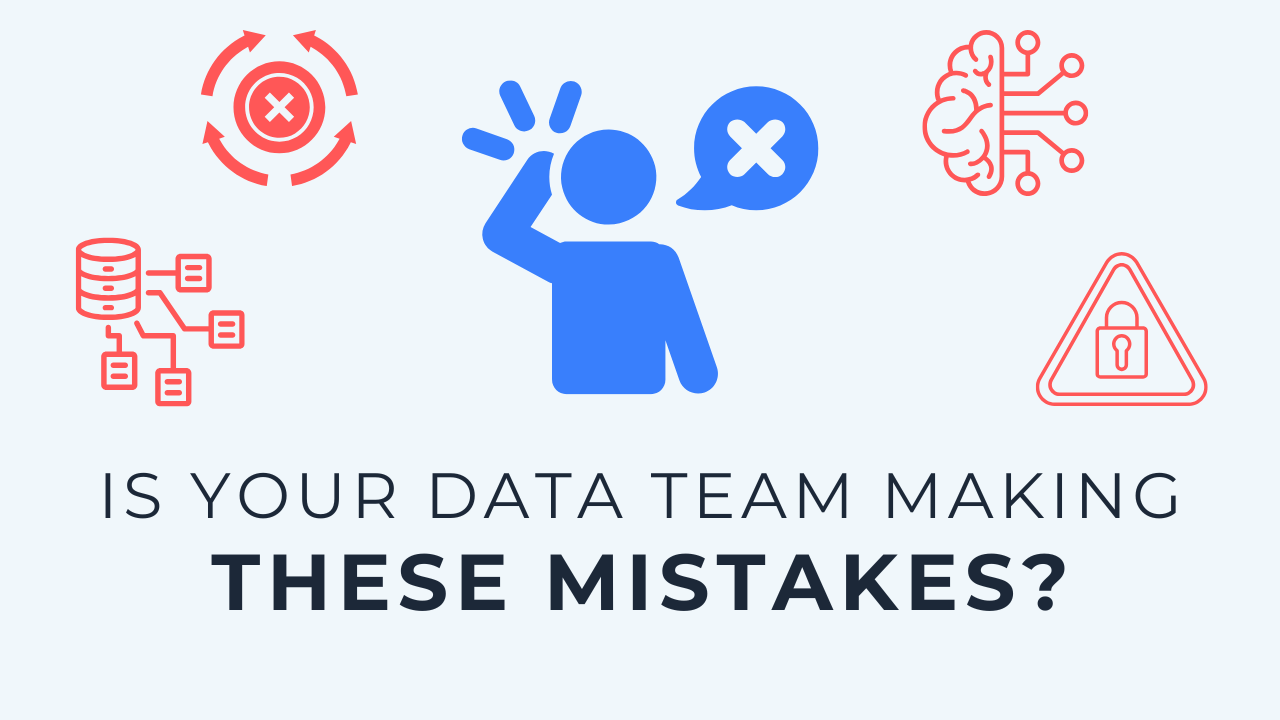
The five mistakes that cost small data teams the most are a lack of data modeling, no defined development workflow, inconsistency in following whatever is already in place, missing database security roles, and over-engineering too soon. None of them break anything on day one, which is exactly why they survive. They get expensive later, when the logic is too tangled to unravel, when nobody can explain who changed what, or when an admin account is wired into every tool you own. The fix in each case is cheap now and painful in two years. If you lead a small team, these are the five things I would audit first.
Key takeaways
- Following some data modeling strategy beats following none. Star schema or Data Vault both give you a method. A pile of views on views gives you a rabbit hole.
- A data workflow is not data modeling. It is how a change gets from a developer's laptop to production without anyone guessing.
- Version control is the hinge. Environments, pull requests and automated testing all hang off it.
- Inconsistency is the mistake underneath the other four. Death by a thousand cuts puts you right back where you started.
- Personal credentials and admin roles couple your architecture to individual people. Dedicated roles and users per use case break that coupling.
- Chasing AI before the foundation exists is over-engineering. Garbage in, garbage out does not care how modern the layer on top is.
- Every one of these gets harder to undo the longer it runs. That is what makes them costly rather than merely annoying.
Mistake 1: A lack of data modeling
This one surprises nobody, and it still trips up more teams than anything else on the list. Data modeling is an abstract thing to talk about, so it gets deferred.
In practice the absence looks specific. The pipeline runs straight from source to report, or there is a database in the middle that follows no clear structure at all.
What it actually looks like
It is usually a pile of custom queries and views, then views on top of those views. Nothing is wrong with any single piece. The problem is that there is no shape to it.
The cost compounds with time. The longer that pattern runs, the harder it becomes to unravel, to change safely, or to explain to anyone new.
Pick a strategy, any strategy
When you follow something, say a star schema or Data Vault, you have a method to the madness. I would argue that following some strategy is better than following none, because at least you can be consistent.
Small teams often feel that this much structure is unnecessary for their size. I disagree. The point of a model is not scale, it is being intentional about how you do analytics.
Mistake 2: No clear data workflow
This is different from modeling. A data workflow is how developers on your team actually make changes, whether that is to the model or to the database itself.
A lot of teams have no process beyond going straight to production. It is still common in 2026 to save directly to production, or straight to the main branch if version control exists at all.
Four things to check
- Version control. Are you on a platform like Git at all. This is the key that the rest of the workflow hangs on.
- A development environment. Does your database line up with your development branches, so a branch and its data are in sync.
- A pre-production environment. Is there anything between development and production, and who operates it.
- Automation. Are changes tested automatically as they move between layers, and recorded through real commits and pull requests.
In my experience this area is brand new for a lot of teams. Those of us who grew up on version control take it for granted, and that assumption is usually wrong.
What you get back
The obvious payoff is efficiency. The quieter one is history: what changed, when, who did it, and why.
That gives you confidence in what you are building and the option to revert to a specific point in time. It is a process, not a product, and a one person team can follow it just as well as a ten person team.
Mistake 3: Inconsistency
This one is the theme running under all of the others. You can have modeling, workflow and conventions defined, and none of it matters if the team is not actually following them.
It starts slow and becomes death by a thousand cuts. An attribute slips into a fact table, a number lands in a dimension table.
A commit message says nothing. Someone saves straight to production again.
How it ends
Over enough time you end up right back where you started, with a new architecture that behaves like the old one. Nobody made a big decision to get there.
The good news is the opposite is also true. Hold the line in each small moment and you never face the big overhaul, because there is nothing to overhaul.
If you lead the team
Nobody enjoys being told to do the tedious thing. But if you set the example, you also have to call it out when work does not meet the standard.
That accountability is what saves you from a much bigger problem later.
Mistake 4: Missing database security roles
This one is tactical and very common. Teams connect every service with an admin role, or worse, with someone's personal credentials.
Ingestion runs as a person. Reporting runs as a person. It works fine right up until that person changes teams or leaves.
The coupling problem
When your own user is the connection, you are coupled to the architecture. Handing it to someone else means handing over your credentials, which nobody wants to do.
The fix is dedicated roles and users per use case. One for ingestion, one for transformation, one for reporting, each with only the privileges it needs.
Why it gets worse with age
This follows the theme of everything above. The longer it runs, the more ingrained it becomes and the harder it is to undo.
Years later you are still looking at an admin account wired into a data ingestion tool, or one developer's connection sitting behind every report on the company dashboard.
Mistake 5: Over-engineering too soon
The first thing a lot of teams want to talk to me about is AI. I understand the appeal completely, and the pressure behind it is real.
The problem is what it pulls attention away from. There is no data modeling in place, no workflow, no consistency, no security roles, and the conversation has already jumped to future state.
The sequence matters
I am not saying those projects are unimportant. I am saying the order is wrong, and moving fast to stand something up on a weak base is a recipe for a bigger mess.
Garbage in, garbage out still applies no matter how advanced the layer on top is. Fix the foundation and the advanced work gets easier, not harder.
The hard conversation
Most people doing the work already know this. The difficult part is usually explaining it to business leaders who only see the thing that got deprioritized.
Framing helps: foundations are not a delay to the AI project, they are what makes the AI project produce a trustworthy answer.
Key terms
Data modeling strategy
A named approach to structuring your warehouse, such as star schema or Data Vault, that your team applies consistently instead of building ad hoc views.
Data workflow
The process a change follows from a developer's branch to production, including version control, environments, testing and review.
Pre-production environment
A layer between development and production where changes are validated before anyone depends on them.
Dedicated database role
A role created for a specific use case, such as ingestion or reporting, so that no tool or report depends on a person's personal credentials.
Over-engineering too soon
Investing in advanced capabilities before the modeling, workflow and security foundations they depend on actually exist.
Common questions
Does a one person data team really need a data workflow?
Yes, and it is cheaper to start there. Workflow is a process rather than a product, so a single developer can run version control, a development environment and pull requests at almost no cost. The habit is what you are building, and adding the second person later is then trivial.
What data modeling approach should a small team start with?
Star schema is the usual starting point because it is well documented and easy to explain to stakeholders. Data Vault is the other common choice. The specific pick matters less than committing to one and applying it consistently.
How do I know if my team has a consistency problem?
Look for small drift. Attributes appearing in fact tables, numeric measures in dimension tables, commit messages with no information, and changes that went straight to production. Any of those on their own is minor, which is exactly how the pattern survives.
Why not just use an admin account for everything?
It works until you need to change it. Admin credentials give every tool more access than it needs, and they make it impossible to see which workload is doing what. Dedicated roles keep access scoped and make activity traceable.
Should a small data team work on AI projects at all?
Not before the foundation is in place. An AI layer inherits whatever quality the model underneath it has, so modeling, workflow and roles come first. Once those are solid, the AI work is faster and far more trustworthy.
Which of the five should I fix first?
Start with version control and a basic workflow, because it makes every other fix safer to attempt. Modeling comes next, then roles. Consistency is not a project, it is how you hold the first three in place.
Related reading
- Don't Overlook Workflow (as a Small Data Team)
- 3 Strategy Killers for Data Teams
- Can Small Data Teams Afford a "Modern" Database?
- The Gift & Curse of Small Data Teams
Final takeaway
Every one of these five shows up in the architecture audits I do with small teams, and none of them looks urgent at the time. They are costly because the price is paid later, by whoever has to untangle them. Fix the foundation while it is still small enough to move.
Additional Free Resources
Starter Guides & Checklists
Explore additional free resources built on the same patterns I use with real clients so you can build your own with structure and confidence. Topics include data architecture, modeling and more specifically for small data teams.