The Stakeholder Dilemma for Data Teams
Apr 30, 2025
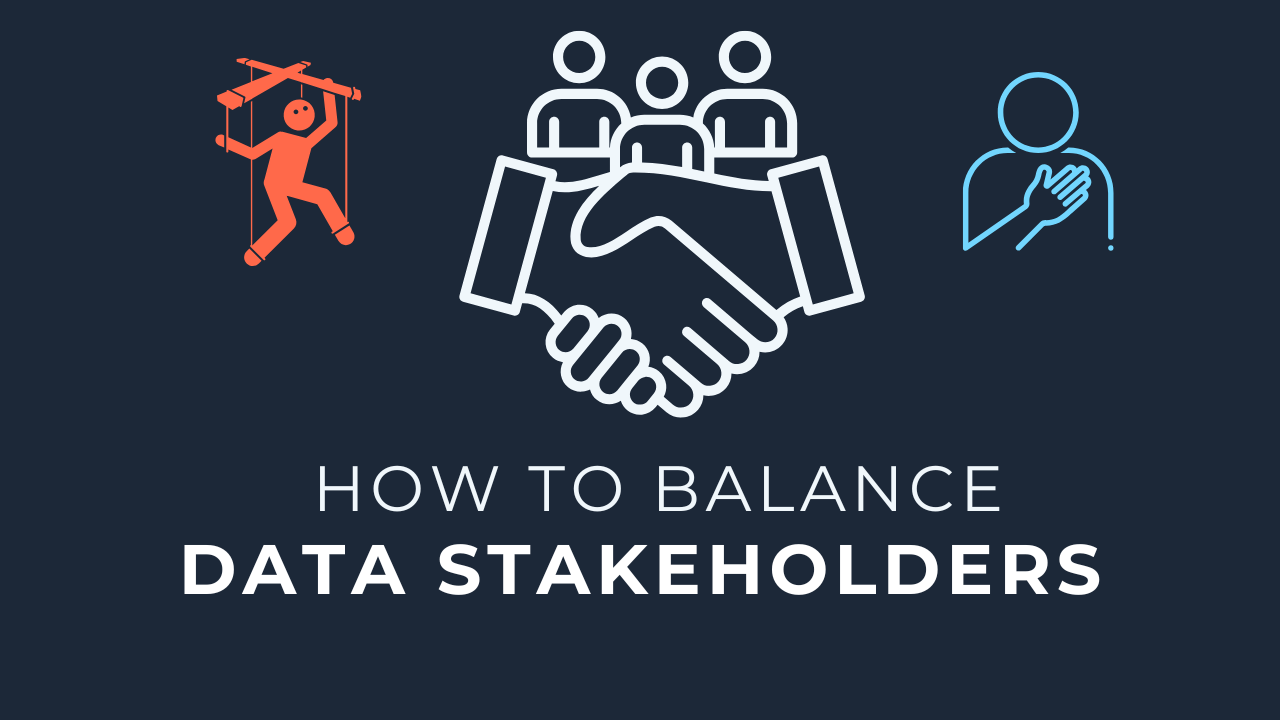
The stakeholder dilemma is the pull between being overly controlling, where you dismiss feedback because you are the one who can see the data, and being overly reactive, where every comment changes the data model. Most teams are not at either extreme, but almost every team leans one way. The useful answer is not a personality fix, it is structural. Split the model into a warehouse layer your team owns and a presentation layer stakeholders can shape, so each side controls what it is actually best at. That split turns a negotiation about who is right into a working process.
Key takeaways
- Overly controlling means no feedback gets in. Overly reactive means the model bends to every comment and stops being coherent.
- Most teams are not at either extreme, but they lean one way. Knowing which way is the first step.
- Architecture solves more of this than diplomacy does. Separate what the data team owns from what stakeholders see.
- The data team owns facts, dimensions, keys and metric logic. Stakeholders own how the presentation layer looks.
- Involving stakeholders in the presentation layer builds trust, which is what protects you when a number looks wrong.
- Front line users know data nuances you cannot know, because they are the ones living in the business process.
The two ends of the spectrum
Stakeholders can be your best friend or your worst enemy depending on how the dynamic has played out. Either way, every data engineer has to manage the balance between reacting too much and controlling too much.
Overly controlling
An overly controlling team does not let feedback in. You believe you have the answers because you have the technical skills and you can see the data itself.
Stakeholders do not get to tell you what to do, the thinking goes, because they cannot see what you see. That position feels defensible and it quietly kills the relationship.
Overly reactive
An overly reactive team takes every piece of feedback and immediately changes the data model.
The cost is a model that is loosely defined and will not scale. It is constantly moving at the whim of whoever gave feedback last, because the goal became appeasing people rather than modeling the business.
Most teams lean, they do not live at the extremes
Very few teams sit fully at one end. But they tend one direction, and it is worth being honest about which one.
The compromise is somewhere in the middle. You are on the same team as your stakeholders, usually at the same company, and the goal is not to settle who is right.
You want to reach a conclusion together, which means neither side wins the argument by default.
Architecture is the part you control
Here is the piece a data team can act on without anyone's permission: the way you structure the model.
Build a warehouse layer that the data team owns. This is where facts and dimensions live, where keys get created, where metric logic is defined at a chosen grain.
Then build a separate presentation layer, the data marts or whatever you call them, that goes out to stakeholders and reporting tools.
A data mart is a focused, business-facing table or view built for one audience, like a sales mart or an operations mart. It is the thing a report points at.
What that split actually prevents
Setting that up alone removes a lot of problems. Stakeholders do not get full visibility into every intermediate model, which would unlock a lot of questions and a lot of confusion.
What they see is the mart layer. This is not about being difficult or implying they should not have access.
It keeps the surface area small enough to reason about. Your team focuses on what it does best, and stakeholders get the results they need.
Let stakeholders own how it looks
The other half of the split matters just as much. On the presentation layer, give stakeholders and analysts real control over what it looks like.
They are the ones using it. They may want to see it a certain way, and they are usually right about that.
The ownership split in practice
- The data team owns the modeling and the engineering: grain, keys, joins, metric definitions, tests.
- Stakeholders own the shape of the output: which fields appear, how they are labeled, how it is presented.
- Both sides review the result, because the mart is the one artifact they can both read.
You still provide input and recommendations. The point is that they have a real sense of ownership, which is where trust comes from.
If something is off in the mart, that feedback goes back into the pipeline and the warehouse layer gets adjusted so the output fits.
They say what they want to see. You build it using good modeling practice, surface it through the presentation layer, and they tell you whether it is right.
Why this is really about trust
This will not work for every company or every team, but it is a good thing to aim for, and the biggest reason is trust.
Here is the pattern without it. A stakeholder compares your numbers to what they see in a business app or another source, decides it looks wrong, and the feedback arrives as a blanket statement that the data is broken.
That judgment is hard to argue with, because they are not reacting to a specific join. They are reacting to a feeling that nobody checked.
What changes when they are involved
When stakeholders are part of the process, they can see that things are trending in the right direction.
More importantly, they trust that you are actually looking at it. The default assumption otherwise is that something was overlooked and the team is not on top of it.
They also trust that you took the time to present it the way they asked. Things will still come up, but the conversation continues instead of stalling.
That is a much healthier dynamic than either extreme: no control on your side, or doing everything you are told.
Where stakeholders know more than you do
Most of this has been from the engineering perspective, because that is what we do and we like to feel like we know what is going on. Often we do have more visibility than the average person at the company.
But there is only so much of the real business use that we can know, because we are busy doing other things.
Front line nuance
People working the front lines of the business, using this data day in and day out, understand nuances we never will.
Something can look cut and dry in the code and the table relationships. The stakeholder knows that because of how the process actually works, it is always a different scenario.
Humbling yourself here is the whole move. They can give you a more accurate representation of the logic than the schema can.
The things you would never guess
Custom formatting rules for certain scenarios. Null values that have an explanation. Joins that look wrong until someone tells you why they are not.
Those are the moments to take a backseat and let them tell you what they want. How you apply it is still your call, and the warehouse and presentation split is where you apply it.
The common complaint stakeholders make about data teams is that we are difficult and slow. Getting out in front of that makes delays easier to forgive when they happen.
It is also more fulfilling to deliver something people use. You can build a technically good pipeline, but if nobody touches the output, what was the real impact?
Key terms
Overly controlling
A data team posture where stakeholder feedback is dismissed on the grounds that only the team can see the underlying data.
Overly reactive
A data team posture where every piece of stakeholder feedback changes the model, leaving it loosely defined and hard to scale.
Warehouse layer
The layer the data team owns outright, holding facts, dimensions, keys and metric logic at a defined grain.
Presentation layer
The curated layer of data marts exposed to stakeholders and reporting tools, which is the only part of the model they need to see.
Ownership split
The agreement that the data team owns how the model is built while stakeholders own how the output looks.
Common questions
How do I handle a stakeholder who wants the data model changed every week?
Move the conversation to the presentation layer. Most of those requests are about how the output looks rather than how the model works, and the mart layer can absorb them without touching facts and dimensions. The requests that genuinely need a model change are easier to spot once the rest are filtered out.
Should stakeholders see the full data model?
Usually not, and it is not about hiding anything. Exposing every intermediate model generates questions and confusion that do not help anyone. A curated mart layer gives them what they need in a form they can evaluate.
What if the data team and the stakeholder disagree on a metric definition?
Treat the business meaning as theirs and the implementation as yours. They know how the process works on the ground, you know how to express that correctly at the right grain. Write the definition down somewhere both sides can see it.
How do you build trust with stakeholders who think the data is wrong?
Involve them before the number is final rather than after. When they help shape the output, a discrepancy becomes a shared investigation instead of an accusation. Trust is what buys you patience the next time something breaks.
Is this realistic for a small data team?
Yes, and small teams benefit most. The split does not require extra headcount, just a deliberate boundary between the models you build and the marts you expose. One person can maintain both layers.
Related reading
- Data Team Stakeholders: Friend or Foe?
- The True Value of a Data Presentation Layer
- What Every Data Team Lead Should Know
- 3 Strategy Killers for Data Teams
Final takeaway
When I come into a team with a stakeholder problem, the fix is usually in the architecture rather than the relationships. Draw the line between the layer you own and the layer they shape, and most of the friction has nowhere left to live.
Additional Free Resources
Starter Guides & Checklists
Explore additional free resources built on the same patterns I use with real clients so you can build your own with structure and confidence. Topics include data architecture, modeling and more specifically for small data teams.